Arw They Drilling Again Near Deep Water Horizon
O n the morning time of 21 Apr 2010, Sara Lattis Rock began aimlessly calling the fire units of various hospitals in Alabama and Louisiana. She was searching for news about her husband, Stephen, who worked on an offshore oil rig in the Gulf of Mexico where a massive explosion had occurred. The blast took place the twenty-four hour period before Stephen was scheduled to return abode from his latest three-week hitch on the rig, a semisubmersible floating unit called the Deepwater Horizon.
In the hours afterwards a spokesperson from Transocean, the visitor that endemic the Deepwater Horizon, called to tell her that an "incident" had required the rig to be evacuated, Sara veered between panic and denial. 1 minute, she was telling herself that Stephen was fine. The next, she was convinced that she would never come across him again. On Facebook, she came beyond frightening messages – "the water's on fire!", "the rig is burning" – posted past the spouses of other workers. At i signal, Sara got on the telephone with one of them, a woman who had her TV tuned to the same channel that she was watching, which was ambulation alive coverage of the blowout. Every bit they peered at the screen, they heard the aforementioned update, describing the smash as a catastrophic accident and raising the possibility that no one on the rig had survived. The news made them drop their phones and scream.
Sara lived in Katy, Texas, a town just west of Houston where she'd grown up and where she and Stephen had settled afterwards getting married. The day afterwards he got dwelling from his hitch, they were planning to meet a real estate agent, having merely received preapproval for a loan to buy a house. Now Sara wondered if Stephen would ever come up domicile. None of the hospital burns units that she tried reaching had any information nigh him.
Eventually, Sara received another call from Transocean, informing her that although the blowout had caused multiple fatalities, Stephen was among those who had managed to escape from the burning rig. The survivors were now being transported by ferry to a hotel in New Orleans, she was told. Later on consulting her mother, Sara tossed some belongings into a suitcase, drove to Houston airport and boarded the next available flight to the Gulf. The following morning, at about 3.30am, she got a call from Stephen, who told her he was on his way to the hotel where she and other family unit members had gathered to wait. "Are you lot OK?" she asked him. "Yeah, I'thousand fine," he said.
Become the Guardian'due south award-winning long reads sent direct to you every Saturday morning
Later on, when she saw him shuffle through the hall that had been cordoned off for surviving crew members, she knew immediately that he wasn't fine. His expression was blank and, like the other survivors, he looked crush-shocked and traumatised. "When he walked in, from the await in his eyes, information technology was obvious that something horrible had happened," she recalled.
I n 1937, a year subsequently he visited the coalfields of Yorkshire and Lancashire, George Orwell reflected on society'due south dependence on the people who extracted these resources from beneath the earth. What Orwell found after descending into the pits – "estrus, racket, confusion, darkness, foul air, and, above all, unbearably cramped infinite" – struck him as a "picture of hell", teeming with miners whose exertions were as invisible as they were essential to society. "In the metabolism of the western world the coalminer is 2nd in importance only to the man who ploughs the soil," Orwell wrote in The Route to Wigan Pier. "He is a sort of grimy caryatid upon whose shoulders most everything that is not grimy is supported."
He went on: "Practically everything we do, from eating an ice to crossing the Atlantic, and from baking a loaf to writing a novel, involves the utilize of coal, directly or indirectly. Information technology is simply because miners sweat their guts out that superior persons tin remain superior. You and I and the editor of the Times Lit Supp, and the Nancy poets and the Archbishop of Canterbury and Comrade X, author of Marxism for Infants – all of us really owe the comparative decency of our lives to poor drudges cloak-and-dagger, blackened to the eyes, with their throats full of coal dust, driving their shovels frontwards with arms and belly muscles of steel."
In Orwell's day, the griminess of coal mining – the ash and dust, the foul air – was physical, staining the clothing, likewise every bit the faces and bodies, of the workers who ventured cloak-and-dagger. Past the time Stephen Rock found himself on the Deepwater Horizon, the taint of working in the fossil fuel extraction industry was less concrete than moral. People who cared about the environment associated the oil industry with disasters like the 1989 Exxon Valdez oil spill and with carbon emissions that imperilled the planet. Information technology was an industry whose pipelines and projects threatened delicate ecosystems similar the Chill national wildlife refuge in Alaska; an industry from which more and more reputable institutions – universities, philanthropic organisations – had begun divesting; an industry that anyone concerned virtually the fate of the earth would sooner protest confronting than plough to for employment.
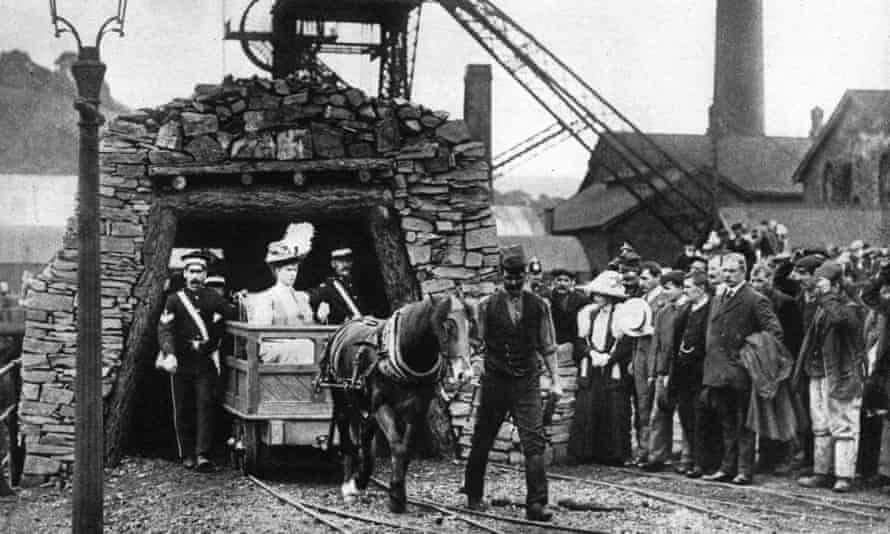
Only while condemning the greed of oil companies was easy enough, avoiding relying on the production they produced was more difficult. For all the talk of shifting to air current and solar power, fossil fuels still supplied 84% of the world's energy in 2019, and in many places their use was increasing. Office of the reason for this was surging consumption in countries like China and Republic of india. Some other cistron was the massive carbon footprint of the Usa, which made upwards less than 5% of the world's population but consumed roughly a quarter of the world'southward free energy. More than 80 years afterwards The Route to Wigan Pier was published, "muddy oil" was no less important in the metabolism of global capitalism than coal had been in Orwell's time. Although he spoke frequently about the importance of addressing the climate crisis, President Obama presided over a massive increase in crude oil production, which grew past 3.6m barrels a mean solar day during his tenure. When Obama left office, the The states was the world's leading petroleum producer. His successor, Donald Trump, was an fifty-fifty more than unabashed promoter of the fossil fuel industry, rolling back environmental regulations and proposing to open ninety% of the US'south coastal waters to offshore drilling.
Stephen Stone did not grow up dreaming of working in the free energy industry. He was far more than interested in enjoying his natural surroundings. Throughout his childhood, his favourite identify to spend time was outdoors, swimming in the Tennessee River or trekking through the wilderness near his home in Grant, Alabama, a small town nestled in the foothills of the Appalachians. The bucolic setting suited him, at to the lowest degree until he got a bit older, when life in a backwoods town with limited opportunities began to feel stifling. During what would have been his senior year in high schoolhouse, he started working the dark shift at a rug mill in nearby Scottsboro, the same manufactory where his mother worked after his parents got divorced. After graduating, he quit the rug manufactory and enlisted in the navy. Two and a half years later, later on being discharged, he returned to Grant and started calling various oil companies to see if he could state a job on a rig. He'd heard that oil companies liked to rent sometime navy guys and the work paid well, far more than any other chore a high school graduate from rural Alabama was likely to stumble across. Some fourth dimension later, he flew to Houston to interview for a position as a roustabout with GlobalSantaFe, an offshore drilling company that would later exist bought by Transocean.
It was on this visit to Houston that Stephen decided to strike up a conversation with the redhead sitting next to him on the drome shuttle. The redhead was Sara. They chatted for three hours; within a twelvemonth, they were married. In some ways, Stephen and Sara made for an odd couple: she was a college graduate with an introspective mode; he was a proficient old boy who was quick with a joke and liked to express mirth and party. From the moment they started talking, though, Sara was struck by Stephen's intelligence, the books he mentioned reading and the thoughtful gaze in his eyes. Whenever he would go offshore on a hitch in the years to come, Sara would notice, Stephen fabricated sure to pack some reading – novels, verse, philosophy. He also brought along a couple of modest notebooks that he would fill with poems and drawings. To some higher graduates, marrying a rig worker, even ane who wrote verse in his spare time, might have seemed odd. To Sara, it felt natural. Virtually everyone she knew in Katy came from a family with ties to the oil manufacture. Her own father had worked in the manufacture for decades. The rhythm of the lifestyle, marked by two- and 3-week hitches during which rig workers were separated from their spouses, was familiar to Sara, who oft went months without seeing her father during her childhood. When Stephen would exit on hitches, she would miss him, but she also liked having time to focus on her own interests, in detail her art. In college, she'd majored in painting and photography, visual mediums through which she'd ever found it easier to express herself than words.
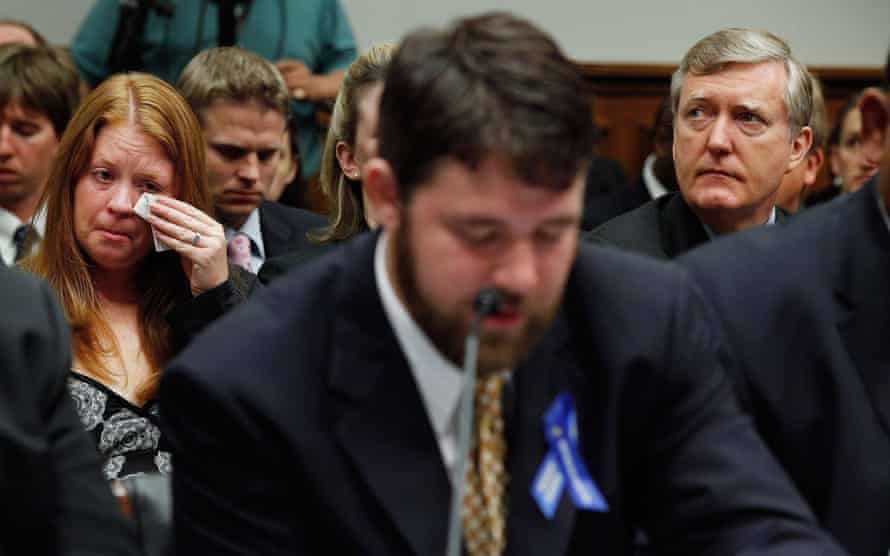
In the aftermath of the explosion on the Deepwater Horizon, Sara started a series of portraits of the blast'southward survivors. The paintings were drafted, fittingly, in oil and were inspired by a visit that she and Stephen paid to Washington DC, where they and other survivors were invited to show at a Business firm judiciary committee hearing on the Deepwater disaster – a disaster that was even so unfolding and that, upon closer inspection, was inappreciably a surprise.
T he immediate crusade of the boom on the Deepwater Horizon was a chimera of methane gas that floated up through the drill column, well-nigh probable because of a breach in the cement casing that enclosed it, and spread across the deck before igniting into a deadly fireball. In the view of many analysts, the deeper crusade was the recklessness and greed that pervaded the oil industry. This seemed especially pronounced at BP, the company that leased the rig from Transocean and owned the exclusive rights to the Macondo Prospect well, an oil and gas reservoir located 49 miles off the coast of Louisiana. "Make every dollar count" was BP'due south motto, an ethos that pleased shareholders and drew praise from business analysts. Safety experts were more alarmed. In 2005, an explosion at a BP refinery in Texas City killed 15 workers. An investigation past the US Chemical Condom Lath faulted BP for pushing for 25% budget cuts "even though much of the refinery'due south infrastructure and process equipment were in busted". Betwixt 2007 and 2010, the Occupational Prophylactic and Health Administration, a regulatory torso, cited BP for 760 prophylactic violations, by far the about of whatsoever major oil company.
Leasing the Deepwater Horizon toll BP $1m a solar day, and the Macondo well had fallen backside schedule, increasing the pressure to brush aside concerns that might have slowed the pace of drilling. Some workers feared that raising such concerns would get them fired, which helps explain why an assortment of ominous signs – problems with the cementing, flaws in the blowout preventer – were ignored. Hours before the rig went up in flames, a BP executive on the rig congratulated the crew for seven years without a "lost-time incident". After the blowout, BP scrambled to contain the oil gushing out of the well, which leaked 210m gallons of crude into the Gulf, devastating fisheries and befouling the coasts of multiple states.
There were too human costs, which Sara sought to capture in her fine art. She painted a portrait of Chris Jones, whose brother, Gordon, was 1 of 11 workers killed in the disaster. In Sara'south portrait, Jones's lips are pursed and his face, painted ash blue, is creased with anguish. Titled Survivors, Sara's paintings were stark and vivid, capturing the raw grief that filled the room at the congressional hearing on the Deepwater spill in Washington. But the portrait she drew of Stephen captured something different. Based on a photo that was taken during his testimony at the congressional hearing, information technology shows a bearded effigy with a vacant, faraway expression in his eyes. He does not look grief-stricken and then much as bewildered and unmoored.
The bewilderment was still credible when I met Stephen several years later, at a bar non far from where he and Sara were living at the time. Stephen was in his belatedly 20s, with a shaggy mop of chestnut-coloured hair and languid, downcast eyes. At the bar, he was taciturn, nodding occasionally at something Sara said while straining to keep his gaze from globe-trotting off. Unlike some of the workers on the Deepwater Horizon, he had managed to escape from the rig without sustaining any burns or physical injuries. But as I would come to learn, the absence of visible wounds was a mixed blessing, prompting friends to wonder what was incorrect with him and exacerbating the shame he felt for struggling to motion on.
Since the explosion, he'd been unable to hold downward a job. He avoided social gatherings. He likewise had trouble sleeping. The explosion on the rig had happened at night, collapsing the stairwell to a higher place the room in which Stephen had fallen comatose later on completing a piece of work shift. The blast startled him awake and sent him racing into the change room, where he slipped on a pair of fire-retardant coveralls and fumbled his way toward the deck, at which point he saw that the entire rig was smouldering and heard the panicked screams of his co-workers. It was an experience he at present feared reliving every fourth dimension he shut his eyes, Sara had come to realise. "The way I understand it is, he's constantly preparing for that wake-up," she said.
In the days that followed, I visited Stephen and Sara several times in their apartment, a two-storey dwelling in a complex of look-alike grey bungalows. Much of the time, Stephen sat on a couch in the living room, sipping blackness java from a light-green mug and, every few minutes, taking another toke of medical marijuana, which a psychiatrist had prescribed to quell his feet. The same psychiatrist had diagnosed him with PTSD.
Given what he'd been through – a near-death experience that shattered his sense of security – this diagnosis made sense. Like military veterans who'd survived explosions in Republic of iraq, Stephen was sensitive to loud noises and given to paranoid fears and panic attacks. The rattle of ice in the freezer was plenty to set him off sometimes, Sara said. Merely as with many military veterans, at that place was something else that seemed to afflict Stephen no less: not fear but acrimony and disillusionment. These feelings percolated immediately after the blowout, he told me, when the rig's survivors arrived at the hotel in New Orleans. They were wearied and even so reeling from the shock, yet before getting to run into their families, Stephen said, they were taken to a meeting room where a Transocean manager delivered a speech that sounded to him similar an exercise in spin. The experience left a bad taste in Stephen'southward mouth. A few weeks later, a Transocean representative reached out to him and, over a cup of coffee at Denny's, offered him $5,000 for the personal holding he'd lost on the rig, which he accustomed. Then the representative asked him to sign a document affirming that he had not been injured. Stephen was dumbfounded. "I'g not signing this," he told the representative. "I don't know if I'm injured yet – this but happened."
When he had practical for the chore at Transocean, Stephen causeless the manufacture followed strict safety protocols. Subsequently the blowout, as he read about how many alarm signs on the Deepwater Horizon had been ignored, a wave of disillusionment washed over him. To some extent, accidents on offshore rigs were unavoidable. But the toll in lives was not the aforementioned in all countries, noted a written report on the Deepwater spill that a bipartisan national committee submitted to President Obama. Betwixt 2004 and 2009, fatalities in the offshore manufacture were "more than four times college per person-hours worked in US waters than in European waters". The report traced this disparity dorsum to the 1980s, when a serial of deadly accidents took place, including an explosion on the Piper Blastoff, a platform in the North Bounding main, that killed 167 people. In Kingdom of norway and the United kingdom, the response was to enact stronger regulations that put the burden of preventing time to come disasters on industry. The Us adopted a laxer approach, leaving safety to companies similar BP and Transocean, which, a few months after the Deepwater blowout, announced that it was application bonuses to several senior executives for overseeing the "best year in safety operation" in the company's history. When Stephen learned near the bonuses, he was still a Transocean employee. Afterward, he submitted an angry resignation letter of the alphabet. "I quit," he said. "I was similar, fuck you guys. I don't want to be a function of your visitor."
Military psychologists sometimes use the term "moral injury" to draw the suffering that some soldiers endure later on they acquit out orders that transgress the values at the core of their identity. Such wounds can also occur when soldiers feel betrayed by their commanders, violating their sense of "what's right". Something like appeared to grip Stephen, who felt deeply betrayed by an industry that upended not simply his sense of security only also his moral bearings and his trust. "I think there's the personal betrayal of the visitor-employee relationship," he said. "Simply there's an even larger sense of betrayal. I didn't think the industry was this bad." He paused. "It but kind of takes some hope from humanity, shatters your illusions a piddling chip."
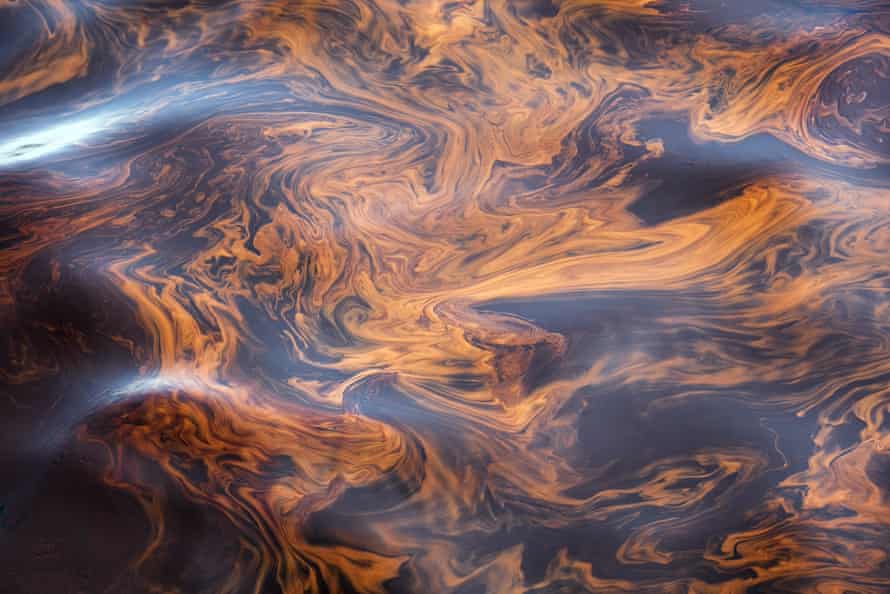
There was ane other betrayal that appeared to weigh on Stephen: the betrayal of himself, the part of him that loved nature and, after the blowout, equally the scale of the disaster became clear, felt dirtied and implicated. He felt this in particular on a route trip that Sara persuaded him to take through some of the places in the Gulf where the pollution from the spill had begun to wash upward. Amid their destinations was Dauphin Island, on Alabama's Gulf Coast. During his childhood, Stephen had holidayed there with his family unit. It was one of his favourite places, famous for the ribbon of pristine white sand that graced its shores. After the Deepwater spill, the sand was stained with oil sludge, a sight that filled Stephen with shame and sadness. "This great place from my babyhood was getting shit on," he said, "and I was office of the grouping that shit on it."
For Sara, besides, seeing the touch on of the spill dredged up difficult feelings about the earth she'd grown upward in. When she watched BP air ads on television burnishing its commitment to the environs, she was furious. Just she was equally upset at ecology groups that, after the spill, seemed to focus far more attending on the pelicans and dolphins who'd been harmed than on the rig workers who'd died. Every twenty-four hour period on the news, information technology seemed, she would see images of dead seabirds and marine mammals. The faces of the rig workers never appeared. Sara could not understand why they were so invisible. "It'southward only weird," she said.
But Stephen did non seem to find it so weird. About of the people he worked with were "blue-collar guys" and "country bumpkins" from backwoods towns like the one he'd grown up in, he noted. The kinds of people "superior persons" looked down on, in other words. Then he mentioned another reason why the public might find it easier to sympathise with dead dolphins than with workers similar him.
"People encounter the surroundings as completely innocent," he said, "whereas we, just being in that manufacture, you know, you lot kind of brought it on yourself."
S tephen did non seem to begrudge people for feeling this way. He had, after all, collected a paycheck from Transocean, making upwards of $60,000 a year as a roustabout, a salary that was spring to increment equally he gained more experience. Were it not for the blowout, he probably would have continued working in the industry, he told me, for the same reason near of the blue-collar guys on the Deepwater Horizon did: the money was good. The aforementioned incentive explained why thousands of working-grade men flocked to places like the Williston Bowl, dwelling house to the Bakken rock formation, during the fracking boom, where drillers and swampers could sometimes pocket more $x,000 a month. Some of Stephen'due south co-workers on the Deepwater Horizon earned six-figure salaries despite having goose egg more than a high school diploma. Equally with fracking, the job was hard – 12-hour shifts during which Stephen raced around stacking equipment and mixing drilling mud – but it beat living paycheck to paycheck with few benefits or holidays like everyone Stephen knew back in Grant, Alabama.
"A path to a life otherwise out of accomplish" was the phrase that a team of reporters from the New York Times used to describe how the crew members on the Deepwater Horizon viewed their jobs. If environmentalists had little sympathy for the workers who took these jobs while ignoring the "dirty facts" about the fossil fuel industry – water pollution, land deposition, the discharge of the bulk of the US's carbon emissions – who, really, could blame them? These dingy facts were real, Stephen best-selling. On the other paw, it was not lost on either him or Sara that a lot of people who saw rig workers as complicit in these dirty facts were happy plenty to pump gasoline into their SUVs and minivans without feeling the least bit sullied themselves. "We like to forget that our everyday lives are what'south making that the reality," Stephen said.
Who ends upwardly doing this kind of work is shaped by class merely also by geography. In a 1994 book, the sociologists William Freudenburg and Robert Gramling compared the status and prevalence of offshore drilling in two states with large shorelines, Louisiana and California. It was in California that, in 1969, a blowout on an oil platform in the Santa Barbara Channel first drew attending to the environmental risks of offshore drilling. The spill prompted then-secretary of the interior Walter Hickel to event a moratorium on offshore drilling in California'south waters. Decades afterward, few residents of the Gilt State were clamouring to change this, Freudenburg and Gramling found. Virtually every Californian they interviewed opposed offshore drilling.
In southern Louisiana, a series of blowouts also took place in the 70s, polluting the Gulf and, in some cases, causing fatalities. But unlike in California, no moratorium on offshore drilling ensued. Past the time Freudenburg and Gramling conducted their written report, more than 13,000 production wells had been drilled in the Gulf of Mexico'due south outer continental shelf. Once again, the subjects of their written report all seemed to hold the same view of this activity, simply this fourth dimension it was the opposite view: in Louisiana, opposition to offshore drilling was nonexistent.
One explanation for these starkly divergent attitudes was ideological: California was a liberal state whose residents tended to intendance nearly the environment, whereas Louisiana was a conservative one where people held favourable views of business organization. But the divergence besides reflected radically dissimilar economic prospects. As Freudenburg and Gramling noted, the Californians they interviewed did non seem to care that closing the coast to drilling might hamper economic development. In fact, many of them were transplants from other states who had chosen to live in California "to get abroad from that kind of shit", equally i respondent put it, describing rigs and derricks as eyesores that would defile the land'south natural beauty, which needed to be protected from development. Louisianians did not take the luxury of thinking this mode. The oil industry meant jobs in a poor state where, for many people, in that location were few better options.
By the end of the 90s, nearly one-third of the US's domestic energy supply came from offshore production in the Gulf of Mexico. To Louisianians who found jobs in the petroleum industry, this was a source of livelihood and a bespeak of pride. But there were meaning downsides, including the highest level of air pollution in the country and the degradation of Louisiana's coastal wetlands. Much of the oil and gas that flowed through the state'due south pipelines ended up servicing other parts of the state, absorbed into the metabolism of prosperous regions like New England. Meanwhile, Louisiana'due south coastal communities were sinking, leaving the residents of cities like New Orleans more than vulnerable to storms and hurricanes, a trouble likely to grow worse in the future, thanks to rise sea levels precipitated by the climate crisis.
A t the commencement of the pandemic, some analysts speculated that the era of dirty free energy was coming to an end. Lockdowns and travel bans caused the global demand for oil to plunge, and at ane indicate, the price of oil futures fell below zero, prompting some to propose that fossil fuels would soon give way to a new era of clean, renewable energy. Simply without support from the world's leading economies, the shift to renewable energy stands little hazard of beingness realised. During Trump'south presidency, such support was sorely lacking from Washington. The calendar appeared to shift under Joe Biden, who announced that he was elevating the climate crisis to a national security priority. Not long after assuming office, withal, Biden urged Opec to increase production in club to convalesce the strain on consumers saddled with high gas prices.
Such cognitive dissonance did not escape the notice of the workers I met. "I realise oil and gas is non the best affair for the surroundings," one former roustabout in Louisiana told me. "How'd you lot become here?" he asked, pointing to the car I'd driven to our date. "I laugh at us that say we demand to get off this – fine, so don't use it," he went on. "They just want it to be somebody else'due south problem."
Although they rarely made the news, oil spills have connected to accept identify with distressing regularity in the decade since the Deepwater blowout – in 2018 alone, in that location were 137, according to the National Oceanic and Atmospheric Assistants. Fatalities are also still common. "From 2008 to 2017, roughly the same number of oilfield workers were killed on the job as The states troops in Transitional islamic state of afghanistan," notes Michael Patrick F Smith, who worked on an oilfield in Northward Dakota during the fracking boom. These deaths, too, rarely made headlines, much to the dismay of Lillian Espinoza-Gala, an manufacture rubber consultant who worked for years on an offshore rig, until an accident killed one of her co-workers and virtually claimed her own life.
When I visited Espinoza-Gala at her office in Lafayette, a city in southern Louisiana, I noticed an award displayed on one wall, recognising her as "one of the first Gulf of Mexico female production roustabouts". On another was a picture of 11 wooden crosses planted on a strip of sand, 1 for each of the workers killed on the Deepwater Horizon. When the blowout happened, it felt similar 9/eleven to her, Espinoza-Gala told me. She turned on a computer and showed me a PowerPoint presentation she'd fabricated near the blowout. Later coming to a slide that showed the faces of some of the victims, she paused. There was Donald Clark, 49, an assistant driller from Louisiana. There was Aaron Dale Burkeen, 37, a crane operator from Mississippi.
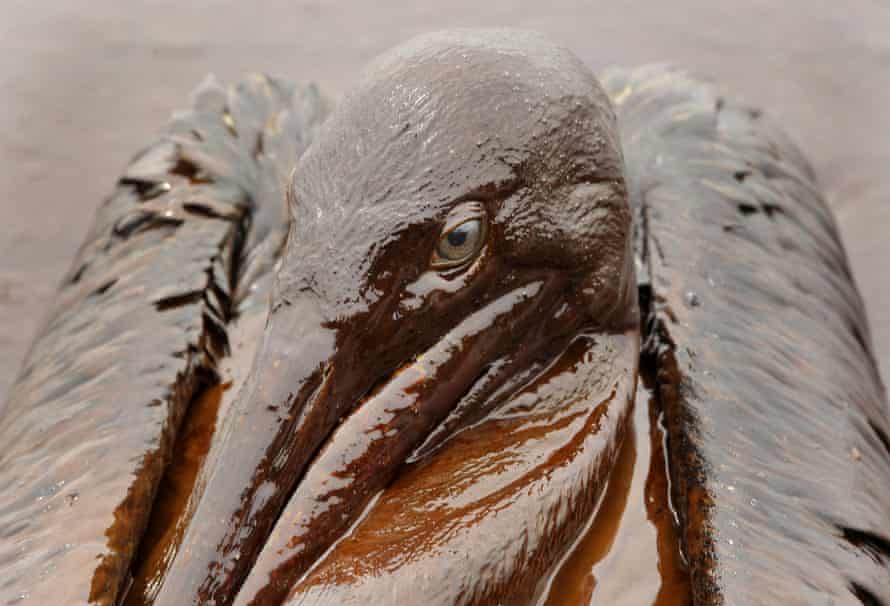
Before shutting down her computer, Espinoza-Gala clicked on i other slide featuring a worker, a bearded man in a navy suit and silk tie who was sitting at a congressional hearing, delivering testimony. It was Stephen Rock. Behind him was a woman with long red hair and freckled cheeks dabbing a tear from her middle. It was Sara. On the next slide, a congressman was shown property up a photo of i of the blowout's better-known victims: a rough-encrusted pelican, Louisiana's country bird.
A proud Louisianian and committed conservationist, Espinoza-Gala was not unmoved by the image of the pelican. But, similar Sara Lattis Rock, she found it hard to empathise why the pelicans aroused more sympathy from politicians than the workers. "The widows were in these hearings, where they're holding up pictures of birds instead of their husbands!" she said. For a long time, she told me, this enraged her. Eventually, she came to terms with information technology, reluctantly terminal that if non for the pelicans, the Deepwater Horizon disaster would probably accept been ignored in Washington, the manner most rig accidents were, owing to the low value placed on the lives of the people who did the dirty work.
"If eleven workers would have died, nobody would accept cared," she said.
This article was amended on 10 January 2022. The Piper Blastoff disaster was caused past an explosion, non a "blowout" equally an before version said.
Adapted from Dirty Piece of work: Essential Jobs and the Subconscious Toll of Inequality past Eyal Press, which will be published by Head of Zeus on xx January
Source: https://www.theguardian.com/news/2022/jan/06/life-after-deepwater-horizon-the-hidden-toll-of-surviving-disaster-on-an-oil-rig
0 Response to "Arw They Drilling Again Near Deep Water Horizon"
Post a Comment