Cant Find Someomesprofile on Grindr Again
Nosotros have discussed Overlapping Subproblems and Optimal Substructure properties in Gear up 1 and Set ii respectively. We also discussed one instance problem in Set 3. Permit the states discuss Longest Mutual Subsequence (LCS) trouble as one more example problem that can be solved using Dynamic Programming.
LCS Problem Argument: Given 2 sequences, find the length of longest subsequence present in both of them. A subsequence is a sequence that appears in the same relative order, simply not necessarily contiguous. For example, "abc", "abg", "bdf", "aeg", '"acefg", .. etc are subsequences of "abcdefg".
In order to discover out the complexity of beast force approach, we need to first know the number of possible different subsequences of a string with length n, i.e., find the number of subsequences with lengths ranging from 1,two,..n-i. Call back from theory of permutation and combination that number of combinations with 1 chemical element are nCone. Number of combinations with 2 elements are nC2 and and so forth and then on. We know that northwardC0 + northC1 + northwardCii + … northwardCnorth = iin. So a string of length n has 2n-one different possible subsequences since we practise not consider the subsequence with length 0. This implies that the fourth dimension complexity of the animal force approach will be O(n * 2n). Note that it takes O(n) time to bank check if a subsequence is common to both the strings. This time complication tin can be improved using dynamic programming.
It is a archetype computer science trouble, the basis of diff (a file comparing programme that outputs the differences between ii files), and has applications in bioinformatics.
Examples:
LCS for input Sequences "ABCDGH" and "AEDFHR" is "ADH" of length three.
LCS for input Sequences "AGGTAB" and "GXTXAYB" is "GTAB" of length 4.
Recommended: Please effort your arroyo on {IDE} first, before moving on to the solution.
The naive solution for this problem is to generate all subsequences of both given sequences and discover the longest matching subsequence. This solution is exponential in term of time complexity. Let us see how this trouble possesses both of import properties of a Dynamic Programming (DP) Problem.
one) Optimal Substructure:
Let the input sequences be Ten[0..m-i] and Y[0..north-ane] of lengths g and n respectively. And let L(X[0..m-i], Y[0..n-1]) exist the length of LCS of the two sequences Ten and Y. Following is the recursive definition of L(X[0..m-ane], Y[0..n-ane]).
If final characters of both sequences match (or 10[m-1] == Y[n-1]) then
Fifty(X[0..yard-1], Y[0..n-ane]) = 1 + L(Ten[0..m-2], Y[0..north-2])
If last characters of both sequences exercise not lucifer (or X[m-1] != Y[n-1]) then
L(X[0..m-1], Y[0..n-1]) = MAX ( Fifty(X[0..m-2], Y[0..n-one]), L(X[0..m-1], Y[0..n-two]) )
Examples:
i) Consider the input strings "AGGTAB" and "GXTXAYB". Last characters friction match for the strings. So length of LCS can be written as:
L("AGGTAB", "GXTXAYB") = 1 + 50("AGGTA", "GXTXAY")
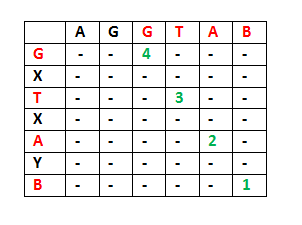
two) Consider the input strings "ABCDGH" and "AEDFHR. Final characters practise not match for the strings. So length of LCS can be written every bit:
L("ABCDGH", "AEDFHR") = MAX ( L("ABCDG", "AEDFHR"), 50("ABCDGH", "AEDFH") )
So the LCS trouble has optimal substructure property as the main trouble can exist solved using solutions to subproblems.
2) Overlapping Subproblems:
Following is simple recursive implementation of the LCS problem. The implementation simply follows the recursive construction mentioned higher up.
C++
#include <$.25/stdc++.h>
using namespace std;
int lcs( char *X, char *Y, int thousand, int n )
{
if (grand == 0 || northward == 0)
return 0;
if (X[1000-i] == Y[northward-1])
return ane + lcs(X, Y, m-1, n-one);
else
render max(lcs(Ten, Y, chiliad, north-1), lcs(Ten, Y, chiliad-i, northward));
}
int master()
{
char 10[] = "AGGTAB" ;
char Y[] = "GXTXAYB" ;
int g = strlen (10);
int due north = strlen (Y);
cout<< "Length of LCS is " << lcs( X, Y, one thousand, north ) ;
render 0;
}
C
#include<$.25/stdc++.h>
int max( int a, int b);
int lcs( char *10, char *Y, int m, int n )
{
if (1000 == 0 || n == 0)
render 0;
if (X[yard-1] == Y[northward-1])
render ane + lcs(X, Y, 1000-1, n-1);
else
return max(lcs(X, Y, 1000, n-1), lcs(10, Y, g-ane, n));
}
int max( int a, int b)
{
return (a > b)? a : b;
}
int principal()
{
char Ten[] = "AGGTAB" ;
char Y[] = "GXTXAYB" ;
int k = strlen (10);
int n = strlen (Y);
printf ( "Length of LCS is %d" , lcs( X, Y, chiliad, n ) );
render 0;
}
Java
public class LongestCommonSubsequence
{
int lcs( char [] X, char [] Y, int m, int north )
{
if (m == 0 || north == 0 )
render 0 ;
if (X[thou- 1 ] == Y[n- 1 ])
return 1 + lcs(10, Y, 1000- 1 , northward- one );
else
return max(lcs(Ten, Y, m, n- 1 ), lcs(X, Y, m- i , n));
}
int max( int a, int b)
{
render (a > b)? a : b;
}
public static void main(String[] args)
{
LongestCommonSubsequence lcs = new LongestCommonSubsequence();
String s1 = "AGGTAB" ;
String s2 = "GXTXAYB" ;
char [] X=s1.toCharArray();
char [] Y=s2.toCharArray();
int g = Ten.length;
int n = Y.length;
System.out.println( "Length of LCS is" + " " +
lcs.lcs( X, Y, thou, n ) );
}
}
Python3
def lcs(X, Y, g, northward):
if m = = 0 or n = = 0 :
return 0
elif Ten[thousand - one ] = = Y[n - 1 ]:
render ane + lcs(X, Y, g - i , northward - 1 );
else :
return max (lcs(X, Y, m, north - 1 ), lcs(X, Y, m - 1 , north));
Ten = "AGGTAB"
Y = "GXTXAYB"
impress ( "Length of LCS is " , lcs(X , Y, len (X), len (Y)) )
C#
using Arrangement;
class GFG
{
static int lcs( char [] X, char [] Y, int m, int n )
{
if (m == 0 || north == 0)
return 0;
if (Ten[m - 1] == Y[due north - 1])
return 1 + lcs(X, Y, 1000 - 1, north - 1);
else
render max(lcs(10, Y, thou, n - 1), lcs(X, Y, one thousand - 1, n));
}
static int max( int a, int b)
{
return (a > b)? a : b;
}
public static void Master()
{
String s1 = "AGGTAB" ;
String s2 = "GXTXAYB" ;
char [] Ten=s1.ToCharArray();
char [] Y=s2.ToCharArray();
int m = X.Length;
int n = Y.Length;
Panel.Write( "Length of LCS is" + " "
+lcs( Ten, Y, m, n ) );
}
}
PHP
<?php
role lcs( $X , $Y , $thou , $northward )
{
if ( $thousand == 0 || $n == 0)
return 0;
else if ( $X [ $m - i] == $Y [ $n - 1])
return i + lcs( $X , $Y ,
$m - 1, $due north - 1);
else
render max(lcs( $10 , $Y , $m , $n - 1),
lcs( $X , $Y , $m - 1, $n ));
}
$Ten = "AGGTAB" ;
$Y = "GXTXAYB" ;
repeat "Length of LCS is " ;
repeat lcs( $X , $Y , strlen ( $X ),
strlen ( $Y ));
?>
Javascript
<script>
function lcs( X, Y , m , due north )
{
if (g == 0 || n == 0)
render 0;
if (X[m-1] == Y[n-1])
render one + lcs(X, Y, m-1, n-1);
else
return max(lcs(X, Y, one thousand, north-1), lcs(X, Y, g-i, n));
}
function max(a , b)
{
return (a > b)? a : b;
}
var s1 = "AGGTAB" ;
var s2 = "GXTXAYB" ;
var 10=s1;
var Y=s2;
var grand = X.length;
var n = Y.length;
certificate.write( "Length of LCS is" + " " +
lcs( X, Y, g, northward ) );
</script>
Output:
Length of LCS is iv
Time complexity of the in a higher place naive recursive arroyo is O(two^n) in worst instance and worst instance happens when all characters of X and Y mismatch i.e., length of LCS is 0.
Considering the above implementation, following is a fractional recursion tree for input strings "AXYT" and "AYZX"
lcs("AXYT", "AYZX") / lcs("AXY", "AYZX") lcs("AXYT", "AYZ") / / lcs("AX", "AYZX") lcs("AXY", "AYZ") lcs("AXY", "AYZ") lcs("AXYT", "AY") In the in a higher place partial recursion tree, lcs("AXY", "AYZ") is being solved twice. If we depict the complete recursion tree, then we can meet that there are many subproblems which are solved again and once more. So this problem has Overlapping Substructure property and recomputation of same subproblems can be avoided by either using Memoization or Tabulation. Following is a tabulated implementation for the LCS problem.
Python3
def lcs(s1 , s2):
1000, due north = len (s1), len (s2)
prev, cur = [ 0 ] * (n + 1 ), [ 0 ] * (due north + one )
for i in range ( i , m + 1 ):
for j in range ( i , northward + one ):
if s1[i - one ] = = s2[j - ane ]:
cur[j] = 1 + prev[j - 1 ]
else :
if cur[j - 1 ] > prev[j]:
cur[j] = cur[j - 1 ]
else :
cur[j] = prev[j]
cur, prev = prev, cur
return prev[n]
s1 = "AGGTAB"
s2 = "GXTXAYB"
print ( "Length of LCS is " , lcs(s1, s2))
C
#include<bits/stdc++.h>
int max( int a, int b);
int lcs( char *X, char *Y, int chiliad, int n )
{
int L[m+one][n+one];
int i, j;
for (i=0; i<=m; i++)
{
for (j=0; j<=northward; j++)
{
if (i == 0 || j == 0)
L[i][j] = 0;
else if (X[i-1] == Y[j-1])
L[i][j] = L[i-1][j-1] + 1;
else
Fifty[i][j] = max(50[i-1][j], Fifty[i][j-ane]);
}
}
return L[k][n];
}
int max( int a, int b)
{
return (a > b)? a : b;
}
int main()
{
char X[] = "AGGTAB" ;
char Y[] = "GXTXAYB" ;
int m = strlen (10);
int n = strlen (Y);
printf ( "Length of LCS is %d" , lcs( Ten, Y, thousand, n ) );
render 0;
}
Java
public class LongestCommonSubsequence
{
int lcs( char [] X, char [] Y, int m, int n )
{
int L[][] = new int [m+ 1 ][n+ one ];
for ( int i= 0 ; i<=chiliad; i++)
{
for ( int j= 0 ; j<=n; j++)
{
if (i == 0 || j == 0 )
L[i][j] = 0 ;
else if (X[i- i ] == Y[j- one ])
L[i][j] = 50[i- 1 ][j- 1 ] + 1 ;
else
L[i][j] = max(L[i- i ][j], L[i][j- 1 ]);
}
}
return 50[m][n];
}
int max( int a, int b)
{
return (a > b)? a : b;
}
public static void primary(String[] args)
{
LongestCommonSubsequence lcs = new LongestCommonSubsequence();
String s1 = "AGGTAB" ;
String s2 = "GXTXAYB" ;
char [] X=s1.toCharArray();
char [] Y=s2.toCharArray();
int chiliad = X.length;
int northward = Y.length;
Arrangement.out.println( "Length of LCS is" + " " +
lcs.lcs( X, Y, 1000, n ) );
}
}
Python3
def lcs(X , Y):
m = len (X)
due north = len (Y)
L = [[ None ] * (north + 1 ) for i in range (m + ane )]
for i in range (m + 1 ):
for j in range (north + one ):
if i = = 0 or j = = 0 :
Fifty[i][j] = 0
elif X[i - 1 ] = = Y[j - i ]:
L[i][j] = 50[i - 1 ][j - 1 ] + 1
else :
L[i][j] = max (L[i - 1 ][j] , L[i][j - 1 ])
return L[thou][northward]
X = "AGGTAB"
Y = "GXTXAYB"
print ( "Length of LCS is " , lcs(X, Y) )
C#
using Organisation;
class GFG
{
static int lcs( char [] X, char [] Y, int grand, int n )
{
int [,]L = new int [chiliad+1,n+1];
for ( int i = 0; i <= m; i++)
{
for ( int j = 0; j <= north; j++)
{
if (i == 0 || j == 0)
Fifty[i, j] = 0;
else if (X[i - 1] == Y[j - i])
50[i, j] = Fifty[i - 1, j - 1] + i;
else
L[i, j] = max(L[i - i, j], L[i, j - 1]);
}
}
return L[thou, n];
}
static int max( int a, int b)
{
return (a > b)? a : b;
}
public static void Main()
{
String s1 = "AGGTAB" ;
String s2 = "GXTXAYB" ;
char [] Ten=s1.ToCharArray();
char [] Y=s2.ToCharArray();
int m = X.Length;
int northward = Y.Length;
Console.Write( "Length of LCS is" + " " +lcs( X, Y, m, due north ) );
}
}
PHP
<?php
part lcs( $X , $Y )
{
$thou = strlen ( $Ten );
$n = strlen ( $Y ) ;
for ( $i = 0; $i <= $m ; $i ++)
{
for ( $j = 0; $j <= $n ; $j ++)
{
if ( $i == 0 || $j == 0)
$Fifty [ $i ][ $j ] = 0;
else if ( $X [ $i - i] == $Y [ $j - 1])
$50 [ $i ][ $j ] = $L [ $i - 1][ $j - 1] + 1;
else
$L [ $i ][ $j ] = max( $L [ $i - i][ $j ],
$L [ $i ][ $j - 1]);
}
}
return $50 [ $chiliad ][ $n ];
}
$X = "AGGTAB" ;
$Y = "GXTXAYB" ;
echo "Length of LCS is " ;
echo lcs( $X , $Y );
?>
Javascript
<script>
function max(a, b)
{
if (a > b)
return a;
else
return b;
}
function lcs(Ten, Y, g, n)
{
var L = new Assortment(m + 1);
for ( var i = 0; i < L.length; i++)
{
L[i] = new Array(n + i);
}
var i, j;
for (i = 0; i <= g; i++)
{
for (j = 0; j <= n; j++)
{
if (i == 0 || j == 0)
L[i][j] = 0;
else if (X[i - 1] == Y[j - 1])
L[i][j] = L[i - 1][j - i] + 1;
else
L[i][j] = max(L[i - 1][j], Fifty[i][j - 1]);
}
}
return 50[m][north];
}
var x = "AGGTAB" ;
var y = "GXTXAYB" ;
var chiliad = x.length;
var n = y.length;
certificate.write( "Length of LCS is " + lcs(10, y, m, northward));
</script>
Output:
Length of LCS is 4
Time Complexity of the above implementation is O(mn) which is much better than the worst-case fourth dimension complexity of Naive Recursive implementation.
The above algorithm/code returns merely length of LCS. Please run across the following post for press the LCS.
Printing Longest Common Subsequence
Yous can also check the space optimized version of LCS at
Infinite Optimized Solution of LCS
Please write comments if you detect anything incorrect, or you desire to share more information about the topic discussed above.
Recent Articles based on LCS!
References:
http://world wide web.youtube.com/sentry?v=V5hZoJ6uK-s
http://www.algorithmist.com/index.php/Longest_Common_Subsequence
http://www.ics.uci.edu/~eppstein/161/960229.html
http://en.wikipedia.org/wiki/Longest_common_subsequence_problem
Source: https://www.geeksforgeeks.org/longest-common-subsequence-dp-4/
0 Response to "Cant Find Someomesprofile on Grindr Again"
Post a Comment